
Key Takeaways
- GLP-1-based medications can be effective tools for chronic weight management when appropriately prescribed and monitored.
- Clinical trials have found weight regain after semaglutide or tirzepatide was discontinued, but the amount varied by study and should not be treated as an individual prediction.
- The frequently cited “two-thirds” figure comes from a specific semaglutide study, not from every GLP-1 medication or every patient.
- Weight management is influenced by medication effects, biology, nutrition, physical activity, sleep, stress, health conditions, routines, and ongoing support.
- Treatment duration is an individual clinical decision. Planning for follow-up and long-term weight management should begin before treatment changes—not after.
What Clinical Trials Tell Us About Weight Regain
One of the most frequently cited findings comes from the STEP 1 extension study involving semaglutide 2.4 mg.
Participants had lost an average of 17.3% of their starting body weight after 68 weeks of semaglutide plus lifestyle intervention. One year after both semaglutide and the study’s lifestyle intervention were withdrawn, participants had regained an average of 11.6 percentage points.
The researchers described this as approximately two-thirds of the group’s prior average weight loss.
That’s an important finding—but also an important distinction.
It does not mean that every person who stops semaglutide will regain two-thirds of the weight they lost. It describes what happened on average in a specific study population under specific conditions.
Another semaglutide study, STEP 4, provides additional context. After an initial semaglutide treatment period, participants were randomized either to continue semaglutide or switch to placebo. Those who switched to placebo gained weight on average during follow-up, while those who continued semaglutide continued losing weight.
Tirzepatide has shown a similar overall pattern.
In SURMOUNT-4, participants first received tirzepatide before being randomized either to continue treatment or switch to placebo. From randomization through week 88, participants switched to placebo experienced a mean 14.0% increase in body weight, while those continuing tirzepatide experienced an additional mean 5.5% reduction.
A systematic review and meta-analysis published in The BMJ also found weight regain after discontinuation across a broader range of weight-management medications and studies.
Taken together, these studies support an important conclusion: weight regain after stopping treatment is a real population-level finding. They do not tell us exactly what will happen to an individual patient.
Why Weight Regain Can Occur After Treatment Changes
GLP-1-based medications can influence appetite, food intake, and feelings of fullness. When treatment stops, those medication effects no longer continue.
For some people, maintaining the same eating patterns or weight may therefore become more difficult without that pharmacologic support.
But weight regulation is much more complicated than any single mechanism.
Sleep, stress, health conditions, other medications, mobility, nutrition, physical activity, daily routines, access to care, and social support can all influence long-term weight management.
That is one reason research findings should inform conversations with a healthcare professional rather than serve as predictions about an individual’s future weight.
Study Averages Are Not Your Personal Outcome
Numbers such as 17.3%, 11.6 percentage points, or 14.0% describe averages observed in particular research populations.
They are not guarantees.
Two people taking the same medication can have very different experiences during treatment and after treatment changes.
The medication, dose, duration of treatment, reason for stopping, follow-up care, health history, nutrition, activity, and many other circumstances can affect what happens next.
A more useful question than “Exactly how much weight will I regain?” may be:
“What is my long-term plan if my treatment eventually needs to change?”
GLP-1 Treatment and the Longer-Term Picture
FDA-approved medications such as Wegovy and Zepbound are used for chronic weight management in appropriate patients, alongside nutrition and physical activity.
That matters because obesity and weight management generally aren’t approached as short-term problems with a single short-term solution.
For some patients, medication may appropriately remain part of treatment for an extended period. For others, treatment may eventually change because of effectiveness, side effects, cost, insurance coverage, pregnancy planning, access, health changes, or personal circumstances.
There isn’t one correct duration for everyone.
Whether to start, continue, change, or discontinue a prescription medication is an individualized decision to make with the prescribing clinician.
Stopping Treatment Isn’t Failure
There are many legitimate reasons someone might need or choose to change treatment.
And if weight increases afterward, that does not erase the progress made while receiving treatment.
Instead, it may be a reason to reassess the weight-management plan.
That conversation can include treatment goals, nutrition, physical activity, behavioral support, follow-up care, other health conditions, and whether another treatment approach should be considered.
Ideally, those conversations begin before treatment changes.
Long-Term Planning Starts at the Beginning
Perhaps the most useful lesson from the research isn’t a particular percentage.
It’s the importance of planning.
Before starting medical weight management, patients can ask:
- How will we determine whether treatment is working?
- How will my progress be monitored?
- What kind of follow-up is included?
- What role should nutrition and physical activity play?
- What happens if cost or insurance coverage changes?
- What should I do if side effects become difficult?
- What would our plan be if this medication eventually needs to change or stop?
Sustainable nutrition, appropriate physical activity, behavioral support, adequate sleep, stress management, and regular clinical follow-up can all support long-term health.
The right combination will differ from person to person.
The Bottom Line
Research showing weight regain after discontinuing GLP-1-based treatment should not be interpreted as evidence that these medications don’t work.
In fact, withdrawal studies demonstrate that continued treatment can help maintain or extend weight-loss benefits in appropriate patients.
The larger lesson is that medical weight management deserves a long-term perspective.
GLP-1-based medications can be effective tools for appropriate patients, but medication is one part of a broader treatment strategy that should include realistic expectations, ongoing monitoring, sustainable routines, and a plan for what happens if treatment needs change.
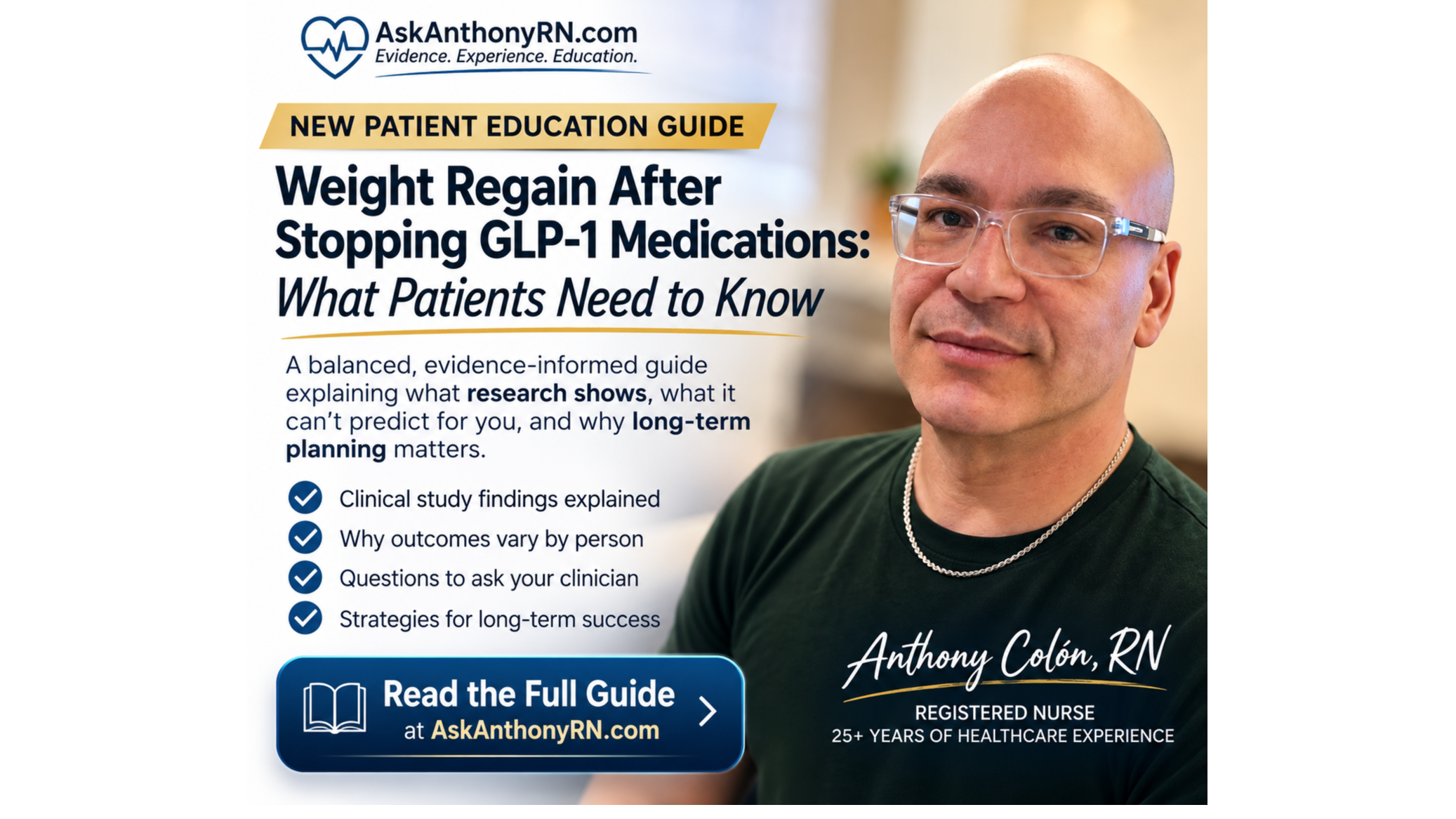
Anthony Colón, RN explains the major studies, their limitations, and practical questions patients can bring to their healthcare professionals in the free Patient Education Guide:
Weight Regain After Stopping GLP-1 Medications: What Patients Need to Know
Read the full guide at https://askanthonyrn.com/weight-regain-after-stopping-glp-1-medications.
Anthony Colón, RN | Wellness & Weight Loss
24 Foch Street
Lewiston
ME
04240
United States


